
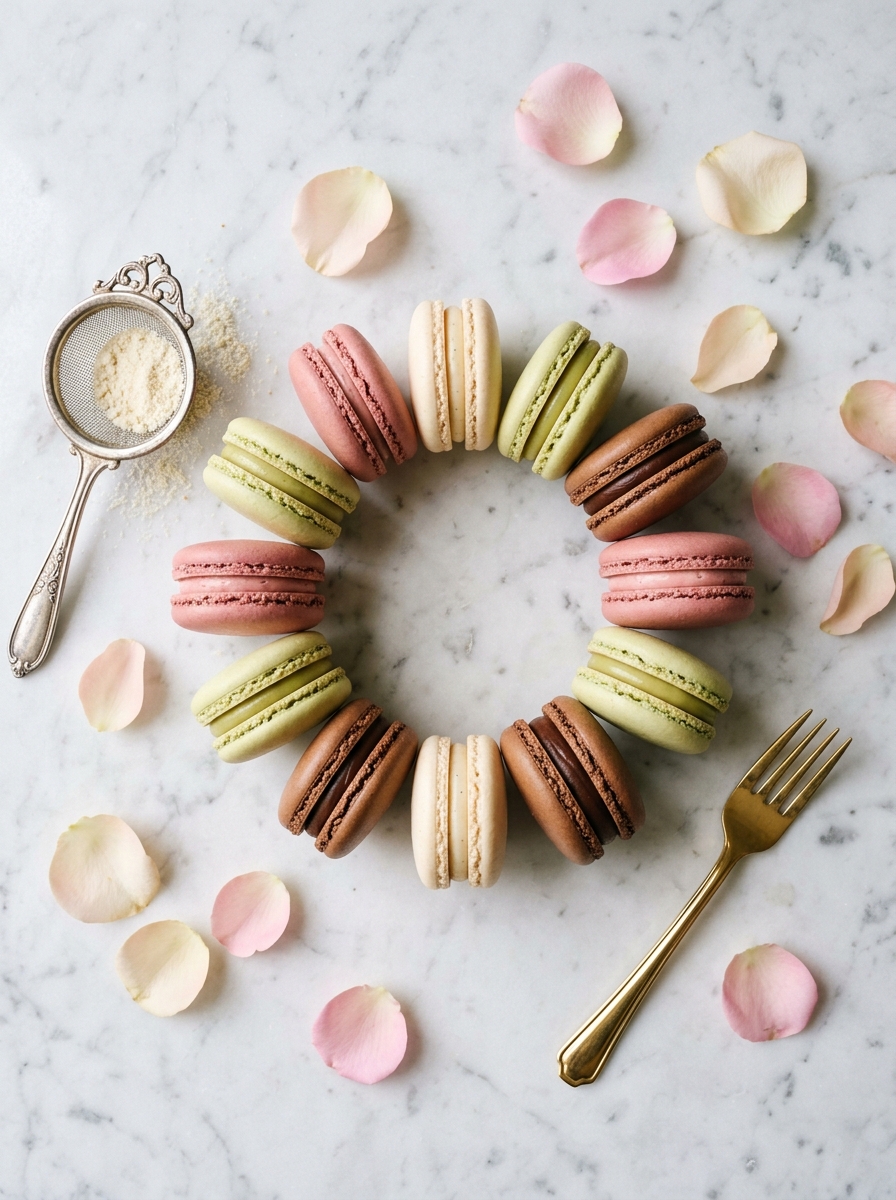
Few things in the pastry world carry the same weight as a Pierre Hermé macaron. The shells are impossibly smooth, the feet perfectly ruffled, and the filling so luxuriously creamy that one bite feels like a front-row seat at his Paris boutique on Rue Bonaparte.
This Pierre Hermé macaron recipe follows his signature Italian meringue method, the same technique he has used for decades to produce some of the world’s most celebrated French macarons.
If your past macaron attempts ended in cracked shells, no feet, or hollow centers, this is the recipe that will change everything.
Follow each step carefully, and within two days you will have bakery-quality macarons resting on your kitchen counter.
| Detail | Info |
|---|---|
| Prep Time | 60 minutes (plus 5 days for aged egg whites) |
| Cook Time | 12 to 14 minutes per tray |
| Total Time | 2 days (including ganache setting overnight) |
| Servings | 36 filled macarons (approximately 72 shells) |
| Difficulty | Advanced |
| Diet Tags | Gluten-Free, Dairy-Free (shell only) |
Why This Pierre Hermé Macaron Recipe Works
The Italian Meringue Method Beats French Every Time
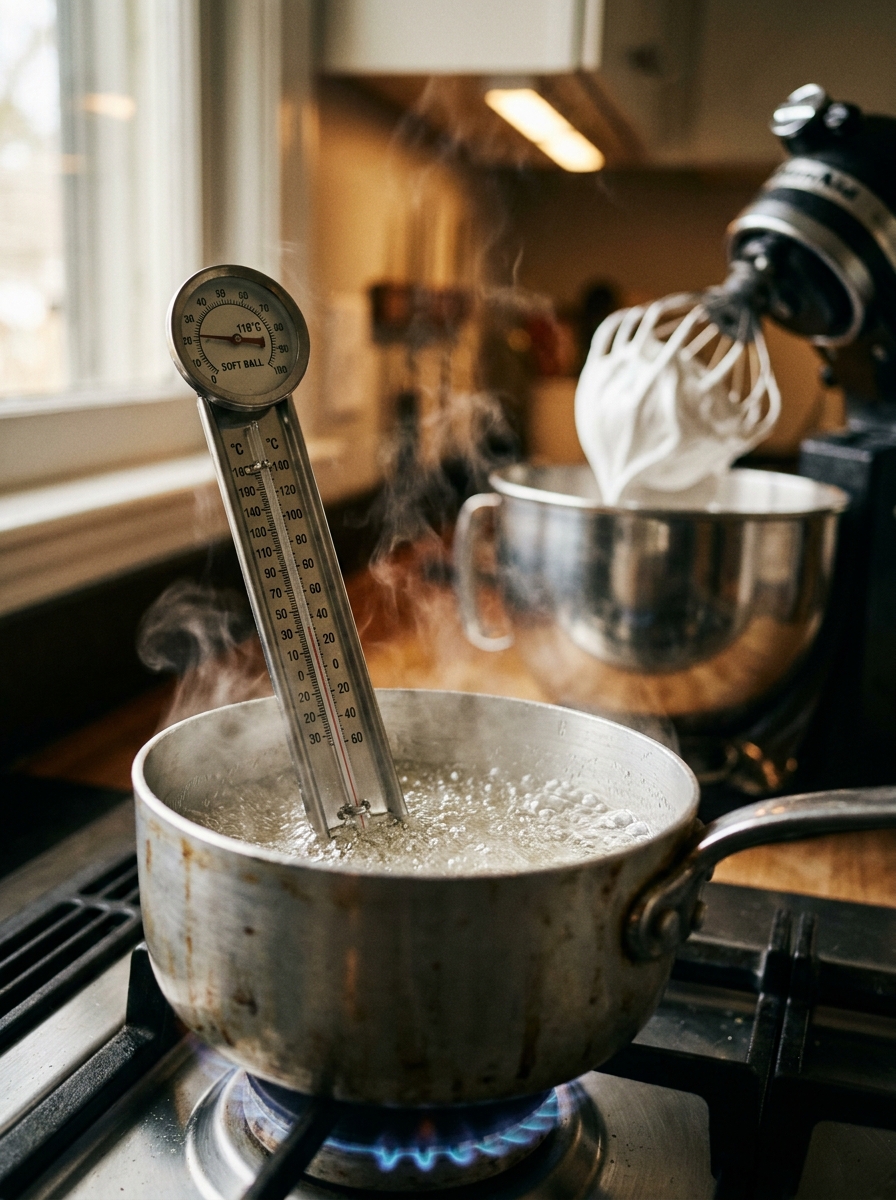
Pierre Hermé uses the Italian meringue method, which means cooking a sugar syrup to 118°C (244°F) before streaming it into beaten egg whites.
This produces a meringue that is significantly more stable than the French method (where raw sugar is folded directly into whites).
The cooked syrup pasteurizes the eggs and sets the protein structure in a way that raw sugar simply cannot. The result is shiner, more evenly formed shells with a more reliable lift.
Aged Egg Whites Are Not Optional
Hermé ages his egg whites in the refrigerator for four to five days before making macarons. During this rest, the albumen proteins begin to break down and the moisture content drops slightly.
The whites become thinner, beat more easily to soft peaks, and are far less likely to over-whip into grainy clumps. This single step solves roughly 40% of the problems home bakers encounter with macaron shells.
The 24-Hour Rest in the Fridge
After assembly, the filled macarons must rest refrigerated for at least 24 hours before serving.
During this time, moisture from the ganache slowly migrates into the shell, transforming it from crisp and slightly dry to that signature chewy-crisp texture Hermé is known for.
Skipping this step means eating an incomplete macaron, no matter how perfectly you baked the shells.
Ingredients
For the Macaron Shells (makes approximately 72 shells / 36 macarons)
Tant pour tant (TPT) base:
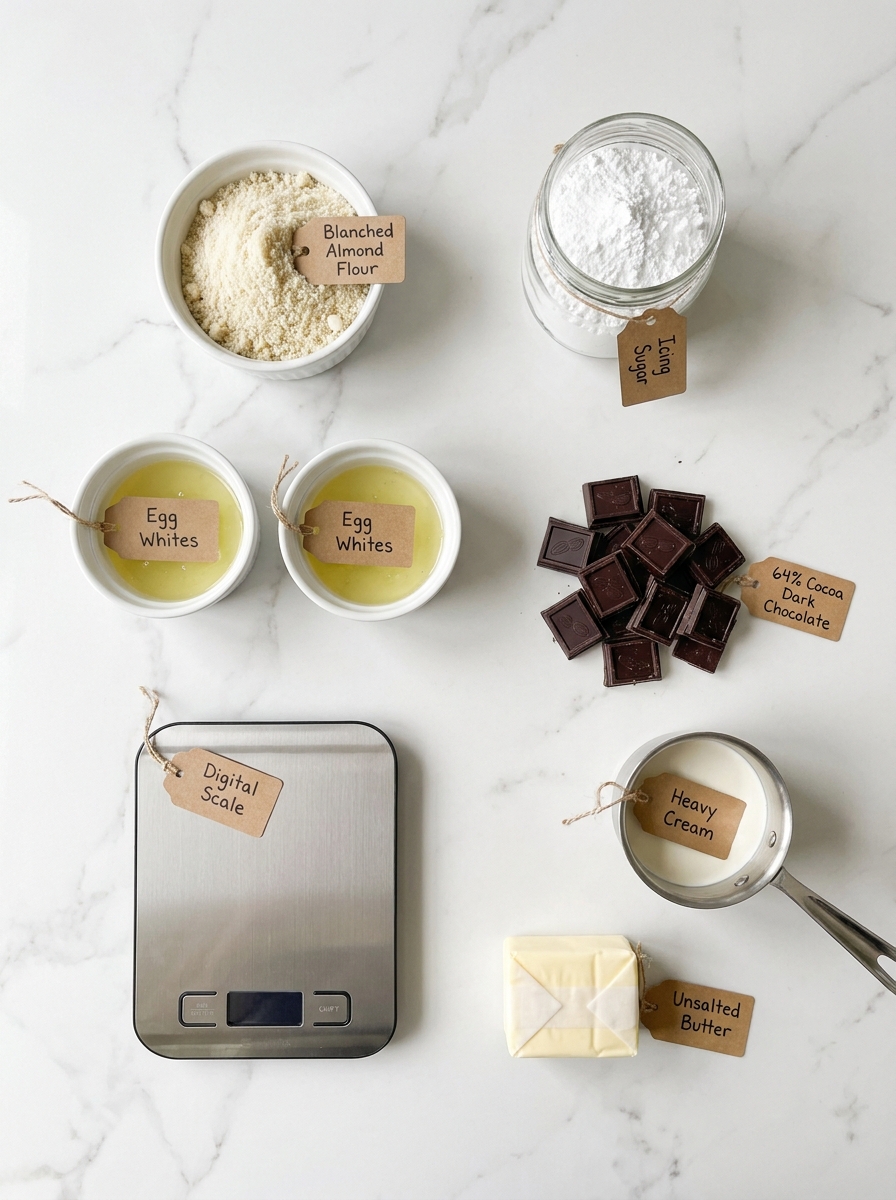
- 300g (3 cups) ground blanched almond flour
- 300g (2 1/2 cups) icing (confectioners’) sugar
- 110g liquefied egg whites (from approximately 3 to 4 large eggs)
- Food colouring of your choice (gel or powder preferred)
Italian meringue:
- 300g (1 1/2 cups) caster (superfine) sugar
- 75g (5 tablespoons) still mineral water
- 110g liquefied egg whites (from approximately 3 to 4 large eggs)
For the Classic Chocolate Ganache Filling (Infiniment Chocolat)
- 500g (2 cups + 2 tablespoons) liquid cream (35% fat)
- 500g (17.5 oz) dark chocolate, 64% cocoa (Valrhona Manjari or similar)
- 145g (5 oz) unsalted butter, at room temperature
Ingredient Notes
Almond flour: Use the finest blanched almond flour you can source. Coarser meal produces a bumpy shell surface. Spread the flour on a baking sheet and dry it in a 100°C (212°F) oven for 10 to 15 minutes before measuring, then sift it at least three times with the icing sugar.
Icing sugar: Choose icing sugar with no added cornstarch if possible, as cornstarch can dull the glossy finish of the shells. In a pinch, standard supermarket icing sugar works, but pure confectioners’ sugar gives cleaner results.
Egg whites: Fresh egg whites must be aged. Place them in a bowl, cover tightly with plastic film, pierce a few holes, and refrigerate 4 to 5 days before use. Egg whites can also be frozen and thawed overnight in the refrigerator as an alternative to aging from fresh.
Water: Hermé specifically calls for still mineral water rather than tap water. The mineral content helps the syrup reach temperature evenly and the lack of chlorine means there is no interference with the egg proteins.
Chocolate: For the ganache, 64% dark chocolate with low cocoa butter variability (like Valrhona) gives the most reliable emulsion. Avoid supermarket baking chocolate, which often has added fats that make the ganache grainy.
Equipment Needed
- Stand mixer with whisk attachment (a handheld mixer works but is harder to control when streaming syrup)
- Candy or digital probe thermometer (non-negotiable)
- Kitchen scale (all measurements by weight)
- Fine mesh sieve
- Large piping bag with a plain round tip, 1cm (3/8 inch) diameter
- Two to three heavy baking sheets
- Parchment paper or silicone baking mats
- Rubber spatula (wide and flexible)
- Small saucepan
Step-by-Step Instructions
Prepare the aged egg whites (5 days ahead): Weigh two separate portions of 110g egg whites into two small bowls. Cover each tightly with plastic film, pierce a few holes in the film, and refrigerate for 4 to 5 days. The whites will become thin and slightly watery, which is exactly what you want.
Make the ganache (1 day ahead): Finely chop the dark chocolate and place it in a large heatproof bowl. Bring the cream to a full boil in a saucepan over medium-high heat. Pour the hot cream over the chocolate in three separate additions, stirring gently from the center outward after each addition. The mixture will look broken and greasy at first. Keep stirring calmly. Once the chocolate is fully melted and the mixture registers 50°C (122°F) on your thermometer, cut the butter into small cubes and add it in three batches, stirring until the ganache is glossy and fully homogenous. Pour into a shallow baking dish, press plastic film directly onto the surface, and refrigerate overnight until it reaches a thick, pipeable, creamy consistency.
Prepare the TPT paste (day of baking): Sift the almond flour and icing sugar together through a fine mesh sieve at least three times into a large wide bowl. Discard any lumps that will not pass through the sieve. Stir your chosen food colouring into the first 110g portion of aged egg whites. Pour the coloured egg whites over the almond-sugar mixture but do not mix. Set this bowl aside exactly as it is.
Prepare the Italian meringue: Combine the caster sugar and mineral water in a small saucepan over medium heat. Stir once to dissolve the sugar, then leave undisturbed and clip your thermometer to the side. Watch the temperature rise. When the syrup reaches 115°C (239°F), begin beating the second 110g portion of aged egg whites in your stand mixer on medium-high speed. By the time the whites reach soft peaks, the syrup should be at or nearing 118°C (244°F). Reduce the mixer to medium speed, then slowly stream the hot syrup in a thin, steady ribbon down the inside of the bowl, not directly onto the whisk. Once all the syrup is in, increase speed to medium-high and continue whipping until the meringue has cooled to 50°C (122°F). The bowl should feel warm but not hot, and the meringue should be thick, glossy, and hold medium-stiff peaks that curve slightly at the tip.
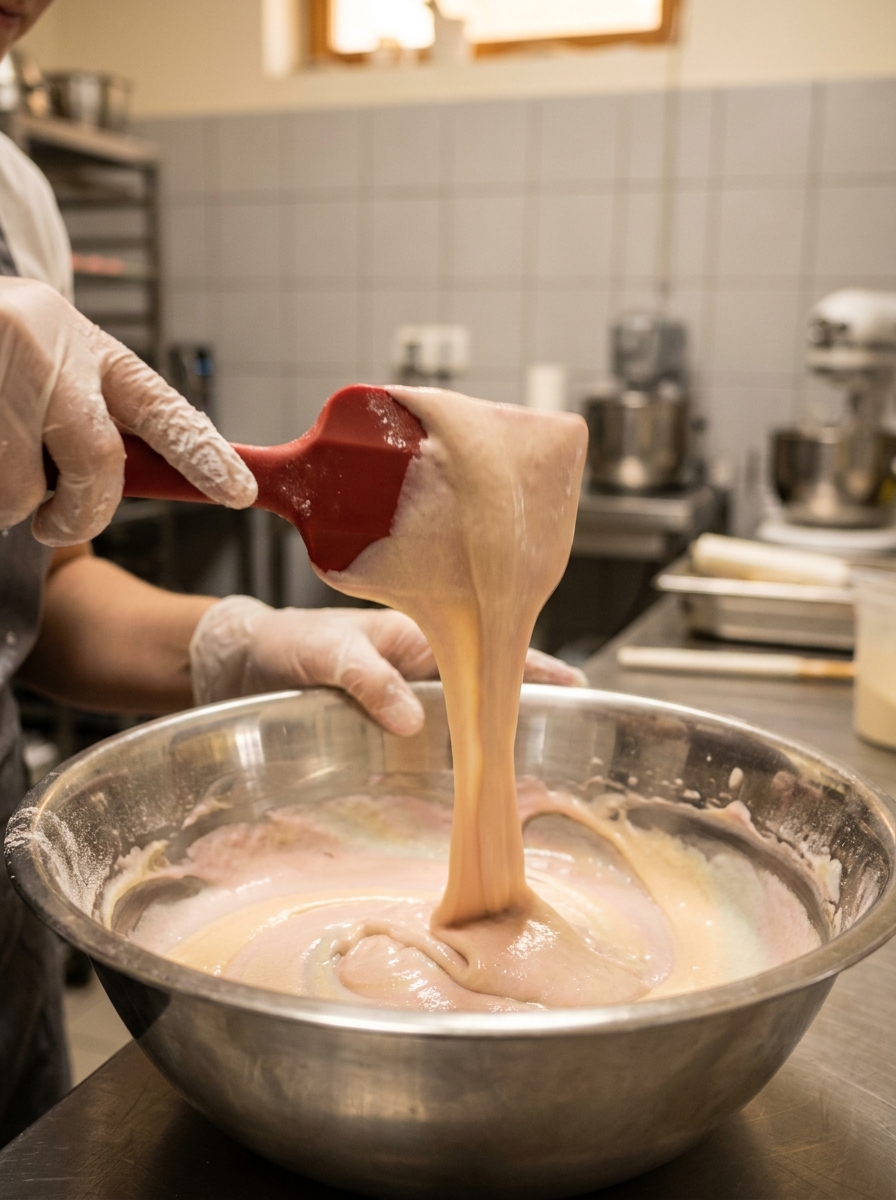
Combine and macaronner: Using a wide rubber spatula, stir the almond-egg white paste vigorously until the egg whites are fully incorporated and the mixture looks like a thick paste. Add one-third of the warm Italian meringue to the almond paste and fold gently to lighten the mixture. Add the remaining meringue in two additions, folding with a deliberate sweeping motion, going down through the center and up along the sides. Now begin the macaronner: press the batter against the sides of the bowl with the flat face of your spatula, then scoop it back to the center. The batter is ready when it flows slowly off the spatula in a continuous ribbon and the ribbon disappears back into the batter within 15 to 20 seconds. It should look like thick lava, shiny and slow-moving.
Pipe the shells: Line your baking sheets with parchment paper. If you like consistent sizing, draw 3.5cm (1 1/2 inch) circles on the underside of the parchment as guides. Fill your piping bag and pipe rounds by holding the bag perfectly perpendicular to the sheet, pressing steadily until the batter reaches your guide, then stopping pressure and lifting cleanly. Space the shells at least 2cm (3/4 inch) apart. Once all shells are piped, lift each baking sheet about 20cm (8 inches) from the counter and let it fall flat twice. This knocks out trapped air bubbles and smooths the surface of each shell.
Rest the shells (croûter): Leave the piped shells at room temperature for 30 to 45 minutes, or up to 1 hour if your kitchen is humid. The shells are ready to bake when you can lightly touch the surface without any batter sticking to your fingertip. The skin you are forming is what forces the steam to escape from the bottom, creating the characteristic ruffled feet.
Bake: Preheat your oven on convection (fan) setting to 160°C to 170°C (320°F to 340°F). Place one tray in the center of the oven. Bake for 12 to 14 minutes, quickly opening the oven door twice during baking at the 5-minute and 9-minute marks to release steam. The shells are done when they slide cleanly off the parchment with no wet base and the feet are firm. Let them cool completely on the parchment before removing.
Fill and assemble: Transfer the ganache to a piping bag with a plain tip. Pipe a generous mound of ganache onto the flat side of half the shells, then sandwich with a matching shell, pressing gently until the filling just reaches the edge. Place the filled macarons in an airtight container, uncovered, in the refrigerator for 24 hours before serving.
Troubleshooting
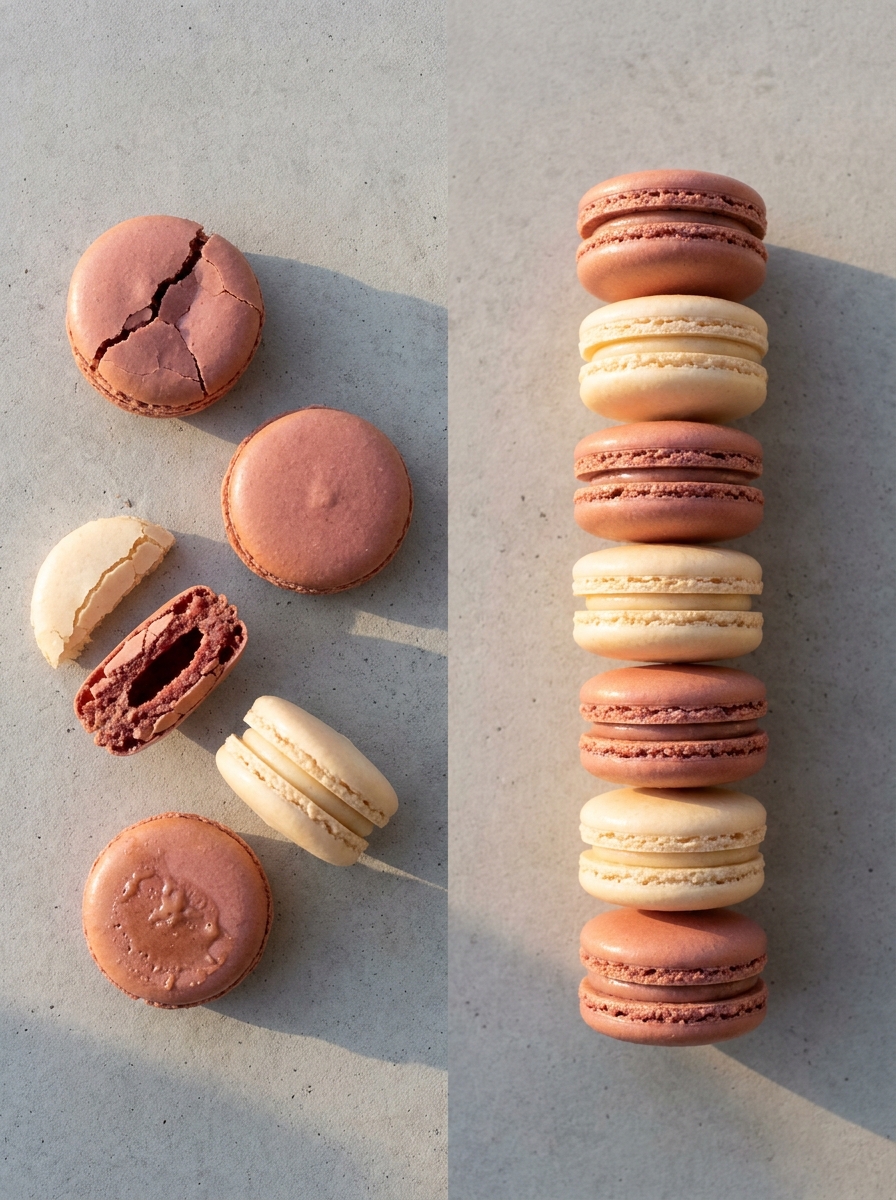
| Problem | Likely Cause | Fix |
|---|---|---|
| No feet or very small feet | Shells not dried long enough (no skin formed) or batter over-mixed | Extend drying time by 15 to 20 minutes; mix batter only to ribbon stage |
| Cracked shells | Shells did not form a skin; oven too hot; air bubbles not released | Dry longer before baking; lower oven 10°C; bang trays firmly after piping |
| Hollow shells | Meringue over-whipped; batter under-mixed; oven temperature too low | Whip meringue only to medium-stiff peaks; macaronner more thoroughly; raise oven 5°C |
| Shells spreading flat | Batter over-mixed; too much moisture in almond flour | Dry the almond flour before use; stop macaronner earlier |
| Sticky, wet base | Oven temperature too low or not enough baking time | Extend bake by 1 to 2 minutes; double up baking sheets to buffer heat from below |
| Grainy, lumpy surface | Almond flour not fine enough or not sifted enough | Run almond flour through a food processor, then sift three times |
Tips for Best Results
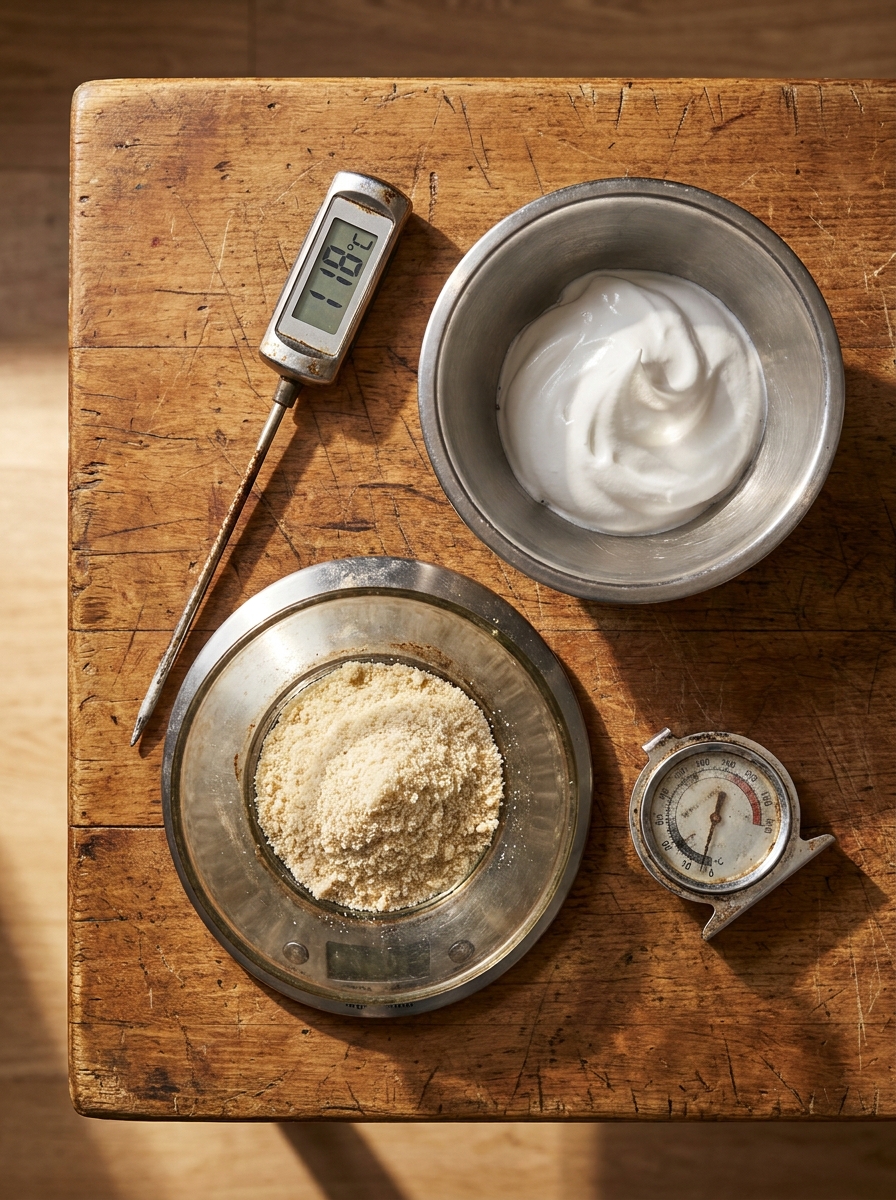
- Use a thermometer obsessively. The syrup temperature is the most critical variable in the whole recipe. One degree above or below 118°C changes the meringue texture noticeably.
- Weigh everything. Volume measurements are unreliable for macarons. A kitchen scale is the single most important tool you own for this recipe.
- Dry your almond flour. Before sifting, spread almond flour on a parchment-lined sheet and bake at 100°C (212°F) for 10 to 12 minutes. This removes residual moisture that causes spreading and oily surfaces.
- Match your shells by size. Sort cooled shells into pairs of nearly identical sizes before filling for a more professional result.
- Check your oven with a thermometer. Most home ovens run hot or cold by 10°C to 20°C. An inexpensive oven thermometer eliminates one of the biggest guesswork variables.
- Colour does not set fully until after resting. Macarons baked with vibrant gel colours will look paler straight from the oven, then deepen to their final shade after the 24-hour refrigerator rest.
Make-Ahead and Storage
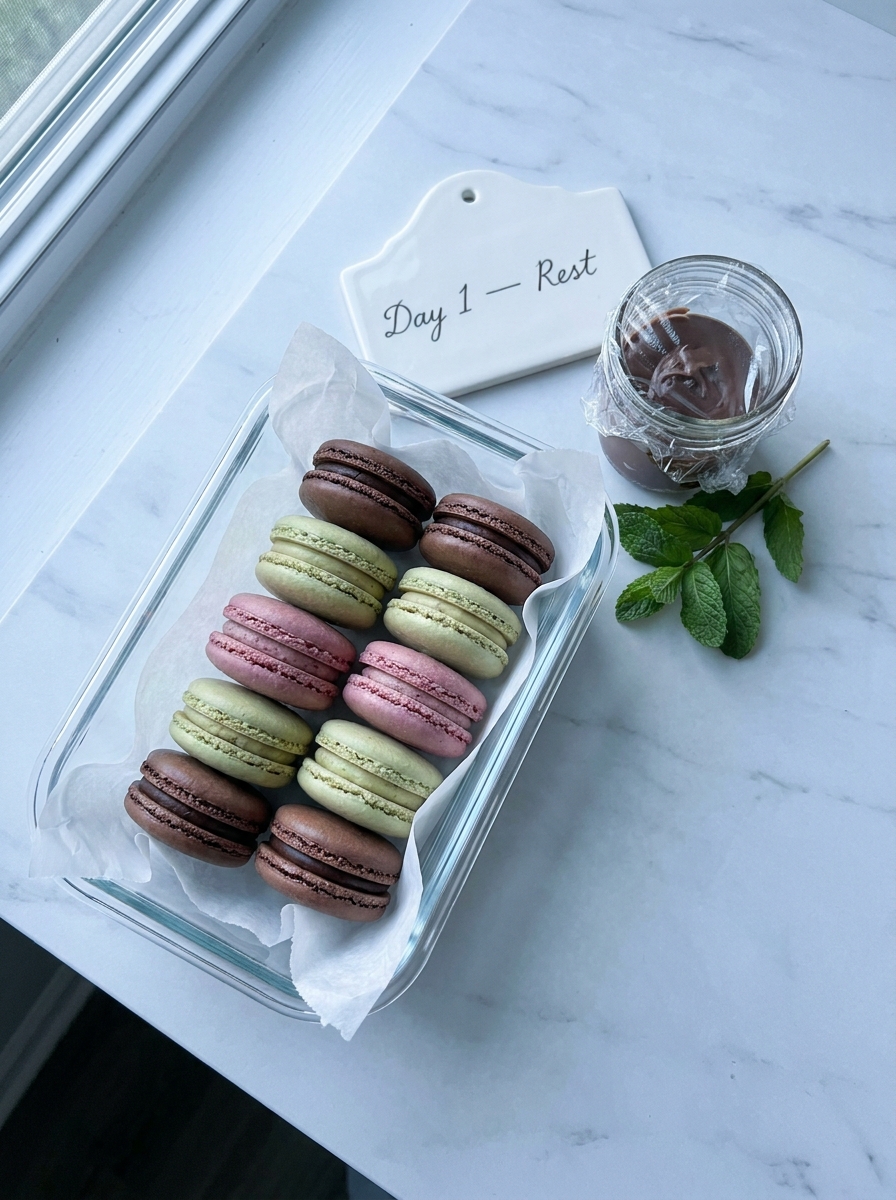
Ganache: Make the ganache 1 to 2 days ahead and store it covered in the refrigerator. Let it come to room temperature for 20 to 30 minutes before piping to soften it enough to flow from the bag.
Shells: Baked unfilled shells can be stored in an airtight container at room temperature for up to 2 days, or frozen (layered with parchment) for up to 1 month. Thaw at room temperature for 30 minutes before filling.
Filled macarons: Once assembled and rested for 24 hours in the fridge, filled macarons keep refrigerated in an airtight container for 3 to 4 days. They can also be frozen for up to 3 months. Allow frozen macarons to thaw in the refrigerator for 3 hours, then at room temperature for 30 minutes before serving.
Reheating: Macarons are a cold-to-room-temperature pastry. Remove from the refrigerator 20 to 30 minutes before serving. They should be cool but not cold when eaten. Never microwave.
Variations and Substitutions
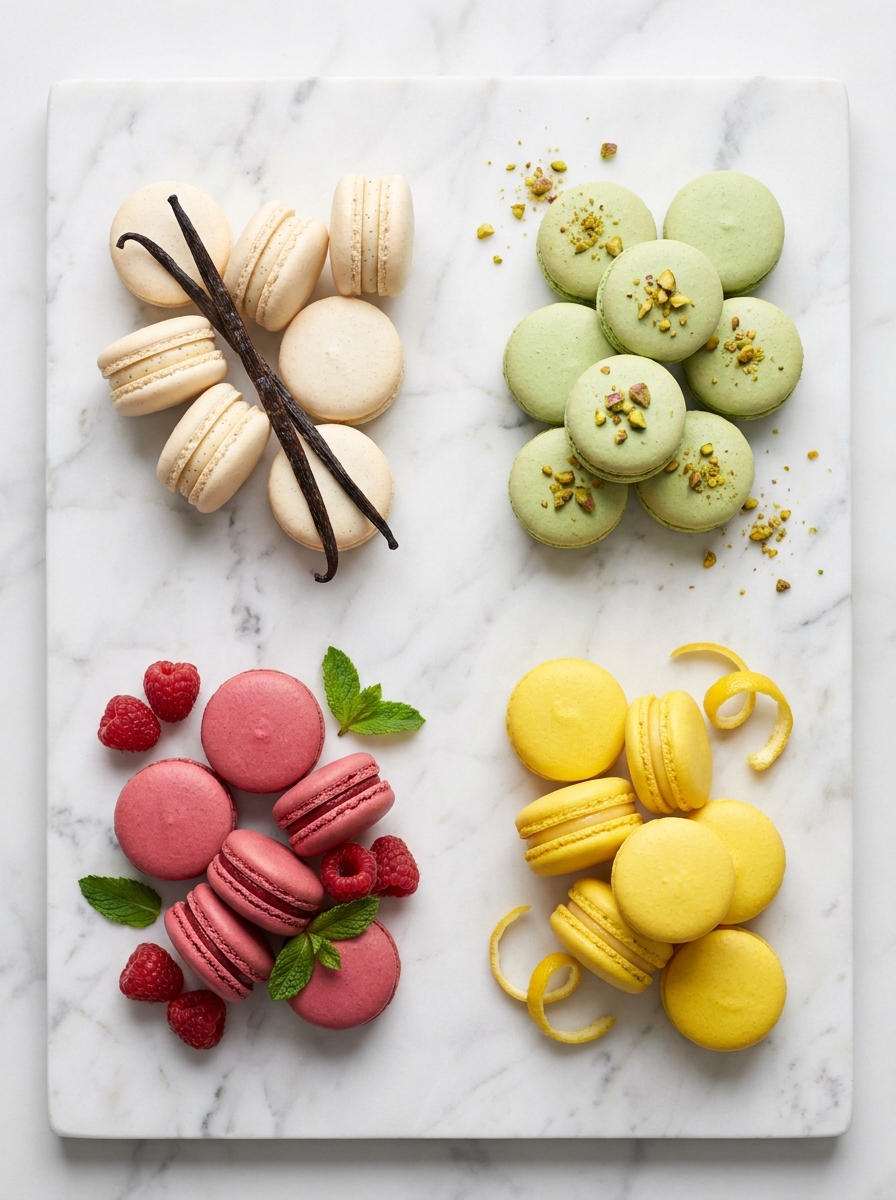
Vanilla macarons: Omit food colouring from the shell and split one vanilla bean into the almond-sugar sift. Fill with a vanilla ganache montée (whipped ganache): bring 100g cream to a boil with 2 vanilla beans, melt into 200g white chocolate, then add 200g cold cream. Refrigerate overnight, then whip until light and fluffy.
Pistachio macarons: Add green gel colouring to the shell. For the filling, replace the dark chocolate in the ganache with 300g white chocolate (Valrhona Ivoire) and stir in 45g pure pistachio paste once the ganache is smooth.
Raspberry macarons: Colour the shells deep pink. Fill with a fresh raspberry buttercream: whip 200g softened butter until pale, fold in 100g fresh raspberry puree (strained), and sweeten with 50g icing sugar to taste.
Lemon macarons: Add yellow colouring to the shell and fill with lemon curd enriched with almond powder, following Hermé’s original curd recipe ratio of 225g eggs, 240g sugar, 160g lemon juice, 350g butter, and 100g ground almonds.
Frequently Asked Questions
Why do Pierre Hermé macarons need aged egg whites?
Freshly separated egg whites contain a high proportion of water and protein strands that are tightly coiled and elastic. Aging in the refrigerator for 4 to 5 days breaks down those protein chains through a natural enzymatic process, producing thinner, more fluid whites. These aged whites whip more readily, create a more stable meringue with fewer air pockets, and produce a smoother macaron batter with a better-defined surface skin.
What is the macaronner technique and when do you stop?
Macaronner is the folding-and-pressing action used to combine the almond paste with the Italian meringue. The goal is to deflate the batter just enough so that it flows slowly and smoothly, without collapsing entirely. You stop when the batter falls off a spatula in a thick, unbroken ribbon and the ribbon takes 15 to 20 seconds to reincorporate. If it disappears immediately, the batter is over-mixed and the shells will spread flat. If the ribbon breaks or drops in chunks, mix a little more.
Can I make Pierre Hermé macarons without a stand mixer?
Yes, a handheld electric mixer works, but it requires a second pair of hands. One person streams the hot syrup while the other keeps the beaters moving. The challenge is that handheld mixers struggle to maintain full speed while simultaneously controlling a 118°C syrup stream. If working alone, warm the bowl to slow the syrup cooling, or use a friend.
Why do my macarons come out hollow?
Hollow shells almost always come from one of three causes: over-whipped meringue that traps excessive air (which then rushes out during baking), under-mixed batter that leaves the center unsupported, or an oven temperature that is too low and fails to set the interior before the shell rises. The 24-hour fridge rest can help reduce the appearance of minor hollows, as moisture from the filling migrates in and firms the interior.
How long do Pierre Hermé macarons last?
Filled macarons are best eaten within 3 to 4 days of assembly when kept refrigerated. The 24-hour maturation rest is essential before the first serving. For longer storage, freeze the filled macarons in a single layer in an airtight container for up to 3 months. The ganache filling freezes beautifully without separating.
What is the difference between French and Italian method macarons?
French method macarons fold regular granulated or icing sugar directly into raw beaten egg whites. Italian method macarons use hot sugar syrup (cooked to 118°C) poured into beating egg whites. The Italian method produces a more stable meringue, glossier shells, and is more consistent across different kitchen humidity levels. Pierre Hermé specifically recommends and uses the Italian method because the results are more reliable and the shells have a better sheen.
Conclusion
The Pierre Hermé macaron recipe is the gold standard for a reason. The Italian meringue method, the aged egg whites, the overnight ganache, and the 24-hour fridge rest are not steps you skip or abbreviate.
They are the reason Hermé’s macarons taste the way they do. Give yourself two days, follow the instructions closely, and you will produce macarons that look and taste like they came from the Rue Bonaparte boutique itself.
If your first batch is not perfect, do not be discouraged. Even professional pastry chefs describe macarons as one of the most technique-sensitive pastries in French cuisine.
Take notes, adjust one variable at a time, and the result gets better with every batch. Share a photo in the comments or tag us if you try this recipe. We would love to see your creations.
Pierre Hermé Macaron Recipe (Italian Meringue Method)
The gold-standard French macaron: glossy smooth shells, perfectly ruffled feet, and a deeply chocolate ganache filling, using Hermé’s own Italian meringue technique.
- Macaron Shells (makes ~72 shells / 36 filled macarons)
- 300g (3 cups) ground blanched almond flour
- 300g (2½ cups) icing (confectioners’) sugar
- 110g liquefied (aged) egg whites — for the almond paste
- Gel food colouring of your choice
- 300g (1½ cups) caster (superfine) sugar
- 75g (5 tablespoons) still mineral water
- 110g liquefied (aged) egg whites — for the Italian meringue
- Chocolate Ganache Filling (Infiniment Chocolat)
- 500g (2 cups + 2 tablespoons) liquid cream, 35% fat
- 500g (17.5 oz) dark chocolate, 64% cocoa (Valrhona Manjari recommended)
- 145g (5 oz) unsalted butter, at room temperature
- Age the egg whites 4 to 5 days ahead: divide into two 110g portions, cover each with pierced plastic film in separate bowls, and refrigerate. The whites will thin and become slightly watery — this is correct.
- Make the ganache 1 day ahead: chop chocolate into a heatproof bowl. Bring cream to a full boil, then pour over the chocolate in 3 batches, stirring from the center after each. Once the mixture reaches 50°C (122°F) and is smooth, add butter in 3 batches and stir until glossy. Press film onto the surface and refrigerate overnight until thick and creamy.
- Sift almond flour and icing sugar together at least 3 times into a large bowl. Discard any lumps. Stir food colouring into the first 110g aged egg whites, pour over the almond-sugar mixture — do not stir yet. Set aside.
- Combine caster sugar and mineral water in a saucepan. Heat undisturbed to 118°C (244°F). When the syrup hits 115°C (239°F), begin whipping the second 110g aged egg whites to soft peaks in your stand mixer.
- Once syrup reaches 118°C (244°F), reduce mixer to medium and slowly stream the hot syrup down the inside of the bowl. Increase speed and whip until the meringue cools to 50°C (122°F) — glossy, thick, with medium-stiff peaks that curl slightly at the tip.
- Fold the almond-egg white paste vigorously until the egg whites are fully incorporated and a thick paste forms. Add 1/3 of the meringue and fold to lighten, then add the remaining meringue in 2 additions.
- Macaronner: press batter against the bowl sides, then scoop back to center. Stop when the batter falls off the spatula in a thick, continuous ribbon that disappears back into the bowl in 15 to 20 seconds. It should look like slow-moving lava.
- Pipe 3.5cm (1½ inch) rounds onto parchment-lined baking sheets, spaced 2cm apart. Hold the bag perpendicular, press steadily, stop pressure before lifting. Bang each sheet firmly on the counter twice to release air bubbles.
- Rest (croûter) at room temperature for 30 to 45 minutes until the shell surface is completely dry to a light touch — no batter should cling to your finger. In humid kitchens, extend to 60 minutes.
- Bake on convection at 160°C to 170°C (320°F to 340°F) for 12 to 14 minutes per tray. Quickly open and close the oven door twice during baking (at ~5 minutes and ~9 minutes) to release steam. Shells are done when they slide cleanly off the parchment with no wet base.
- Cool shells completely on the parchment before removing. Pipe a generous mound of ganache onto the flat side of half the shells. Sandwich with a matching shell, pressing gently until filling reaches the edge.
- Place assembled macarons uncovered in an airtight container in the refrigerator for 24 hours before serving. This maturation step transforms the texture from crisp to perfectly chewy-crisp. Remove from the fridge 20 to 30 minutes before eating.
* Nutrition is estimated per filled macaron. Actual values may vary based on specific ingredients, filling quantities, and shell size used.
